
info@datatroops.io
THE PHANTOM ORDER PROBLEM: THE APOLOGY STRATEGY
Jashan Goyal
Founder & CEO
Distributed Systems Architect
Specializing in Microservices
15+ years in software engineering
Summary
Have you ever seen money deducted but the order disappeared? This isn’t just a rare bug—it's the Phantom Order, a fundamental problem in distributed systems. This guide explores how to solve it using the Saga Pattern, moving from rollback-based recovery to the 'Apology Strategy' for eventual consistency.
Meet Alice and the Phantom Order
Meet Alice. Alice has spent weeks hunting for the elusive 'SuperGamer Console.' Finally, she spots one, the last one on your e-commerce site. Her heart races. She clicks 'Buy Now.' The loading spinner spins... and spins... and then, a generic error message pops up: 'Oops! Something went wrong.'
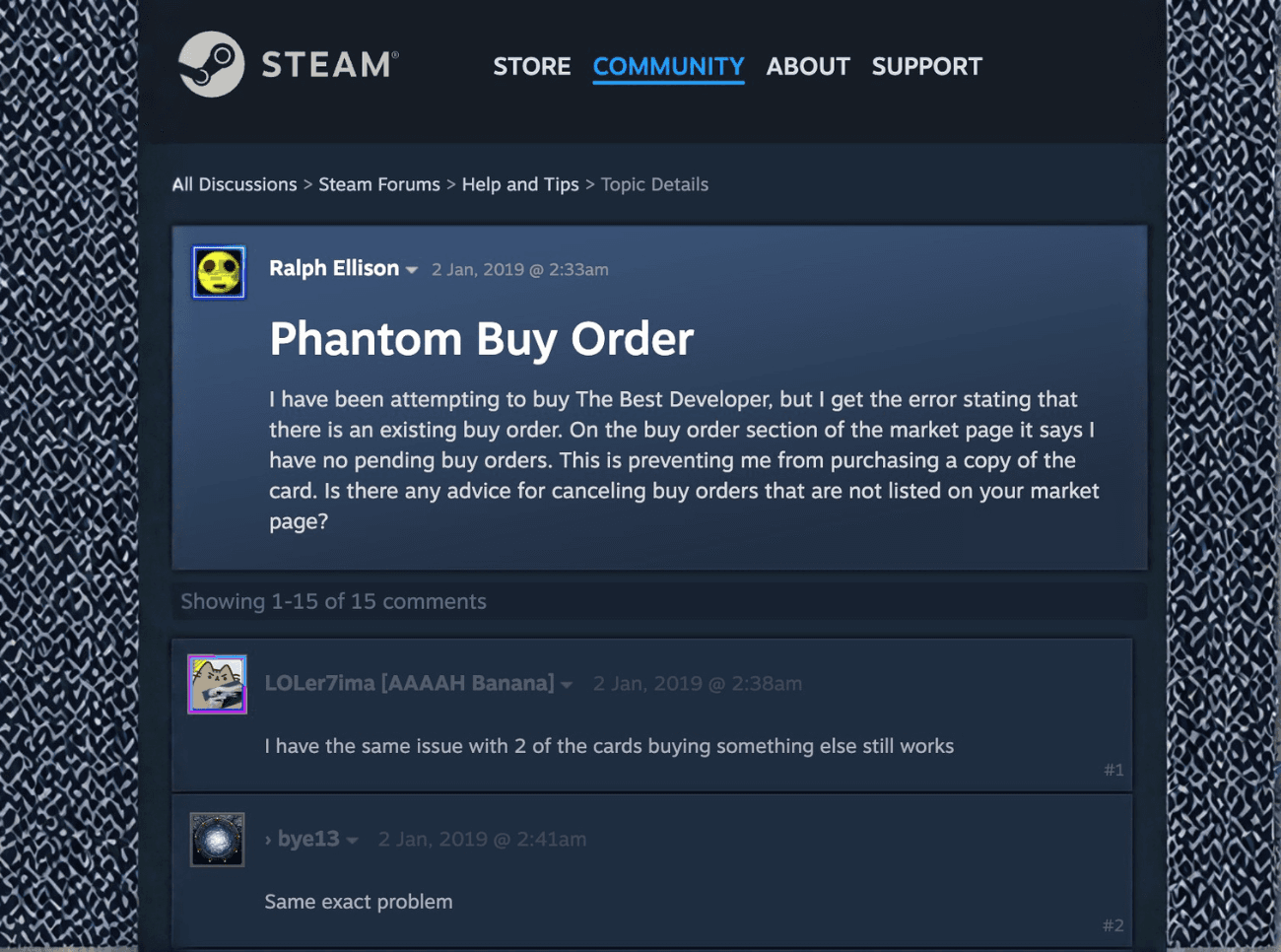
Alice checks her email—nothing. She checks her 'My Orders' page—empty. Then she opens her banking app: -$500.00 PENDING CHARGE. Her wallet is lighter, but your system has no record of her order. She has paid for a ghost.
This is the Phantom Order, a fundamental problem that haunts every distributed system architect. In a microservices architecture, services fail independently. The service that takes the money might succeed, while the service that delivers the product crashes. Because they don't share a database, there is no magic 'Undo' button.
Why Rollback Used to Work (The Monolith Era)
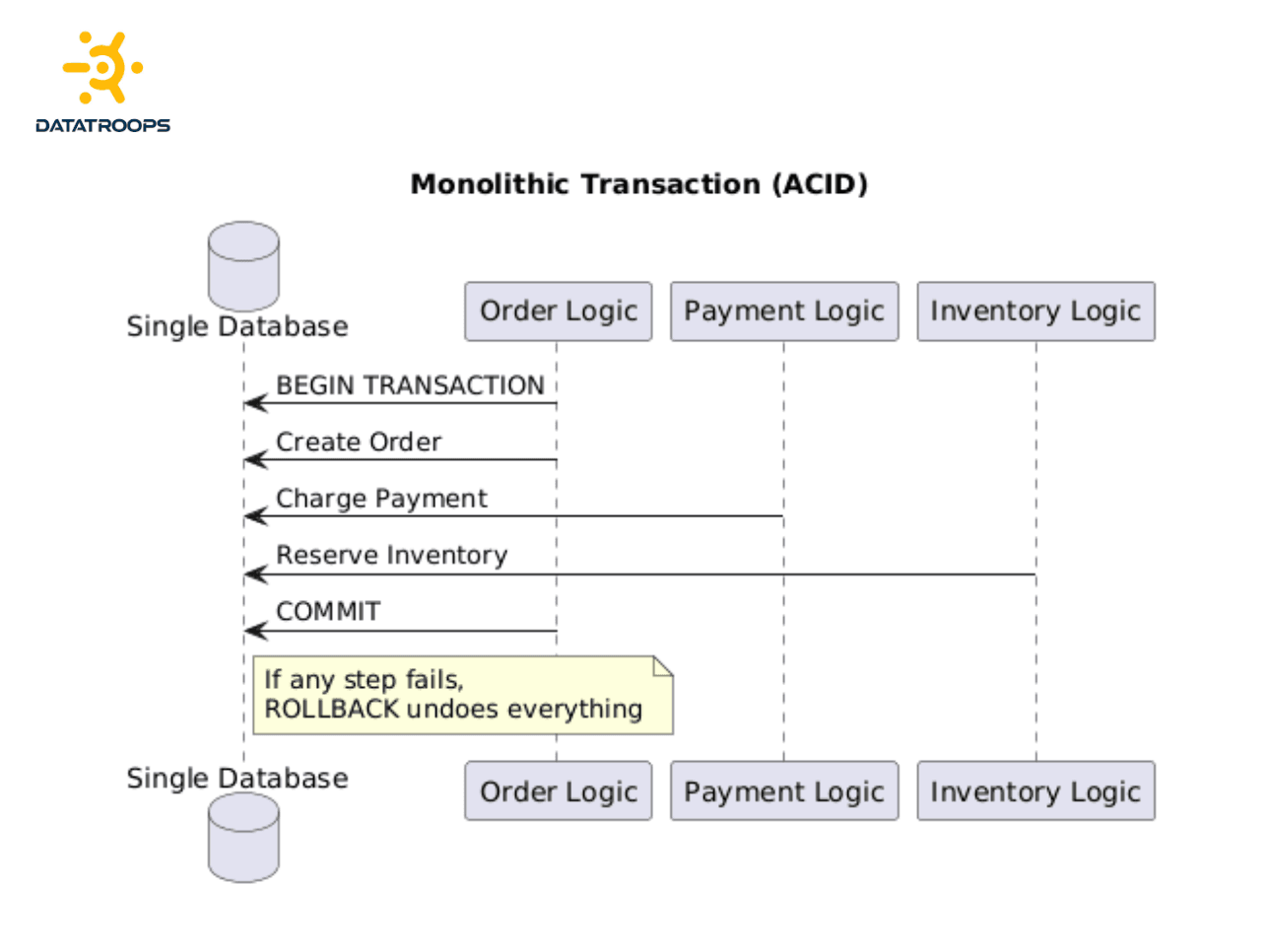
In a monolith, the Order, Payment, and Inventory modules all shared a single relational database. We wrapped their operations in a single ACID transaction. If the inventory update failed, the database triggered a ROLLBACK.
BEGIN TRANSACTION;
  INSERT INTO orders (user, item) VALUES ('Alice', 'PS5');
  UPDATE accounts SET balance = balance - 500 WHERE user = 'Alice';
  UPDATE inventory SET stock = stock - 1 WHERE item = 'PS5';
COMMIT;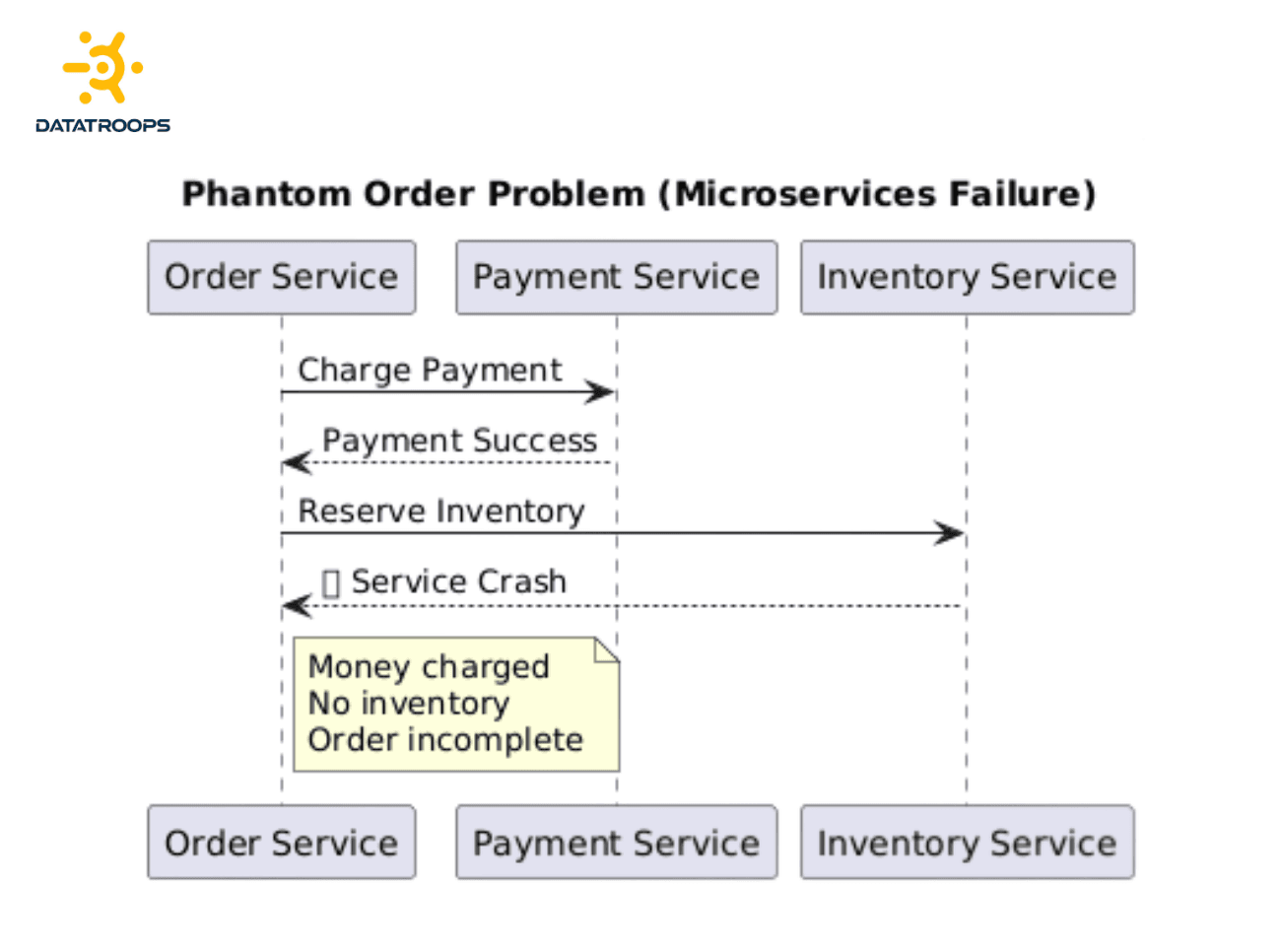
The database physically rewound history. The order vanished, the stock count reverted, and Alice’s money reappeared. This worked because reality hadn't happened yet—we didn't send emails or call external APIs until after the commit.
Why Rollback Is Dead in Microservices
In a distributed architecture, the Payment Service and Inventory Service have their own databases, often on different servers. When the Payment Service charges Alice’s card, it commits to its local database. That transaction is written in stone.
If the Inventory Service crashes 100 milliseconds later, it cannot reach across the network and tell the Payment database to 'un-commit.' Once a service commits, the past is immutable. There is no global rollback button.
The Mindset Shift: Backward vs. Forward Recovery
Monoliths use Backward Recovery: They use an eraser to wipe the slate clean. Distributed Systems use Forward Recovery: They use a pen to cross out the mistake and write a correction.
Real-world Analogy If you accidentally charge a customer’s credit card, you can’t go back in time. You can only do one thing: Issue a Refund. You don't erase the past; you apologize for it.
What Is a Saga?
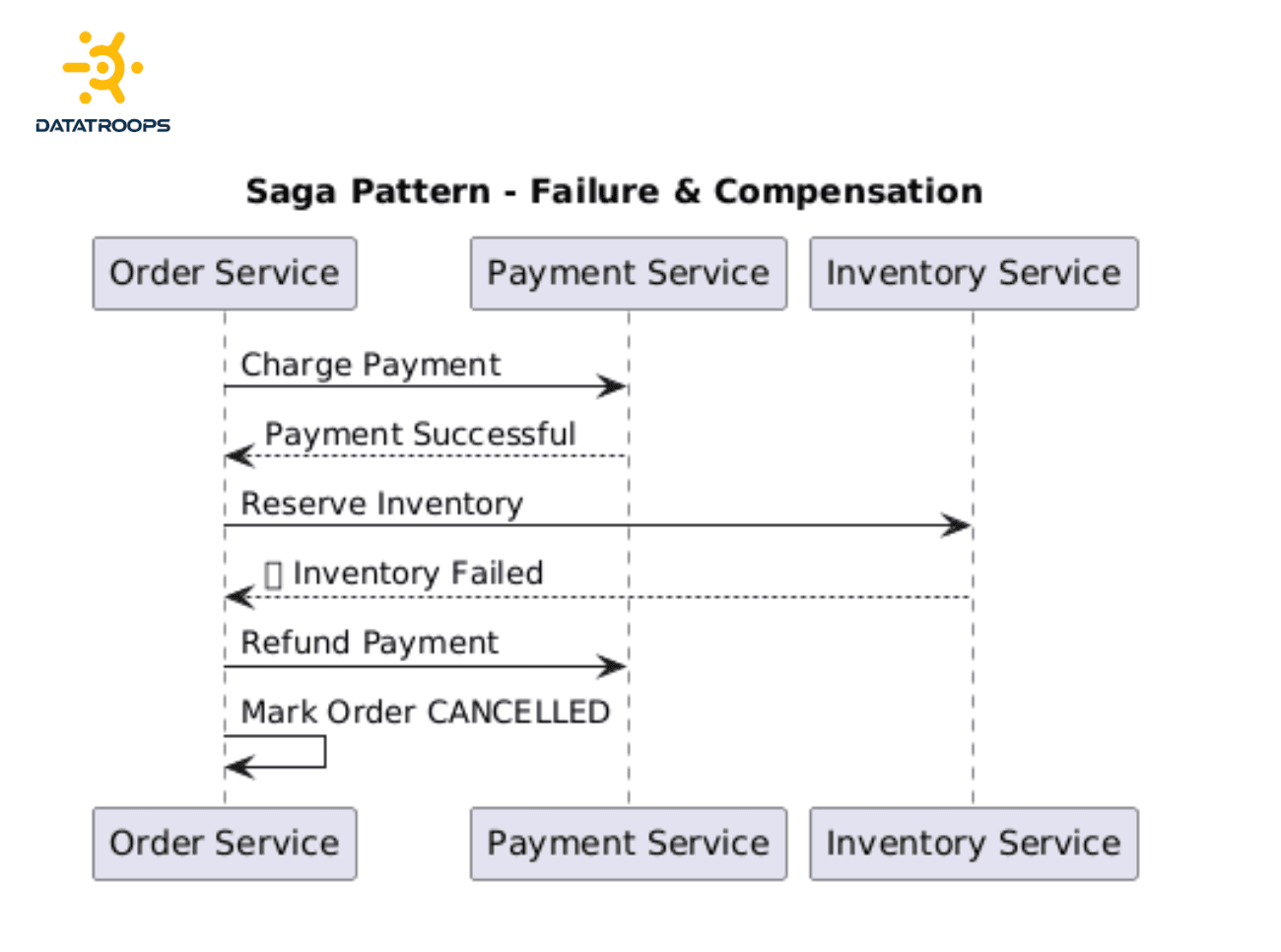
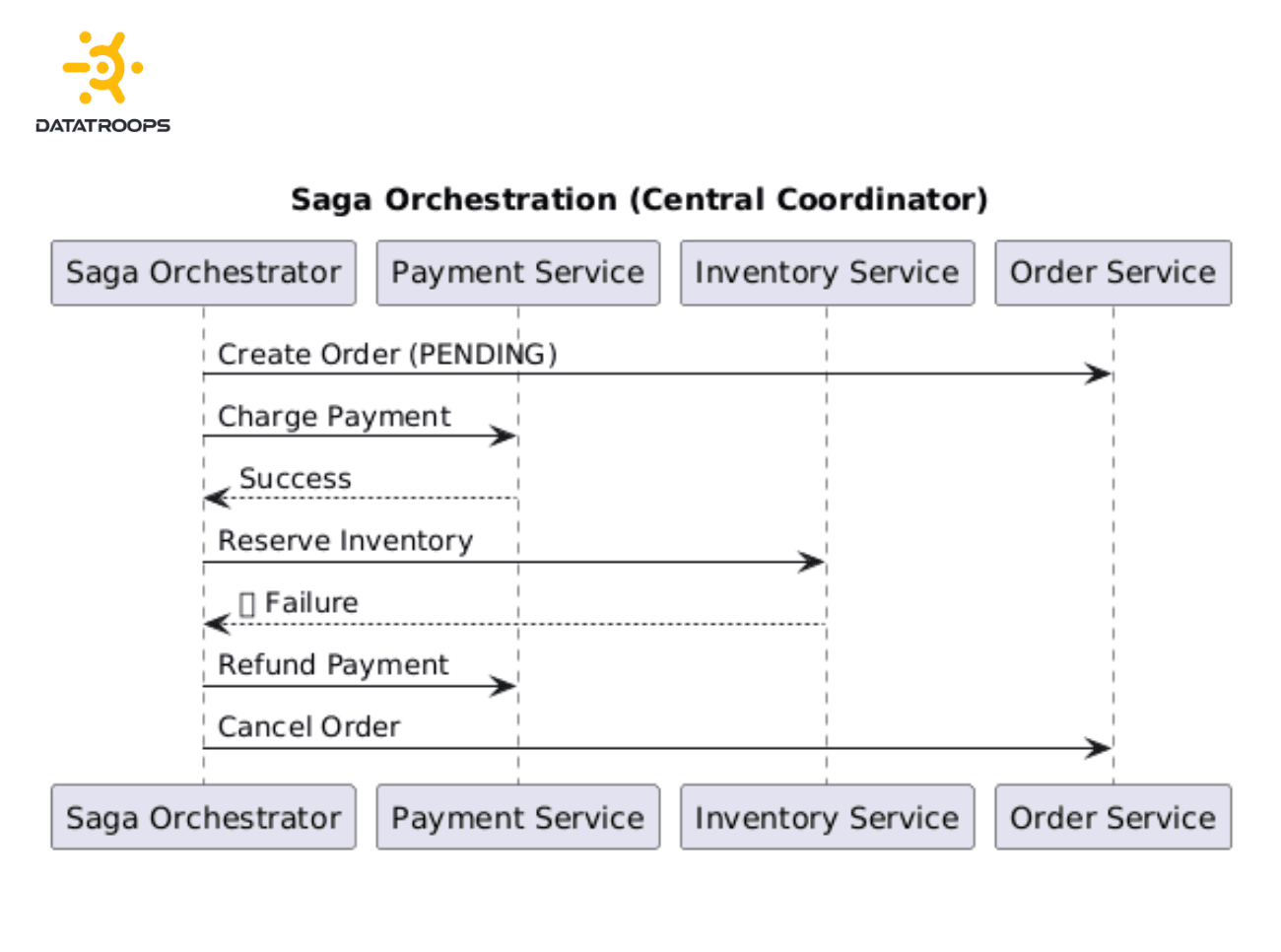
A Saga is a sequence of local transactions. Each service performs its step and publishes an event to trigger the next. Crucially, for every step (like 'Charge Card'), we define a corresponding Compensating Transaction (like 'Refund Card').
If a step fails, the Saga reverses gear and executes compensations for every step that succeeded. The goal is Eventual Consistency.
Compensation Is NOT Rollback
In a rollback, the 'Charge' record disappears. In a Saga compensation, the 'Charge' record stays forever, and a new 'Refund' record is added next to it.
Transaction Ledger Transaction 101: Charge $500 Transaction 102: Refund $500
Choreography vs. Orchestration
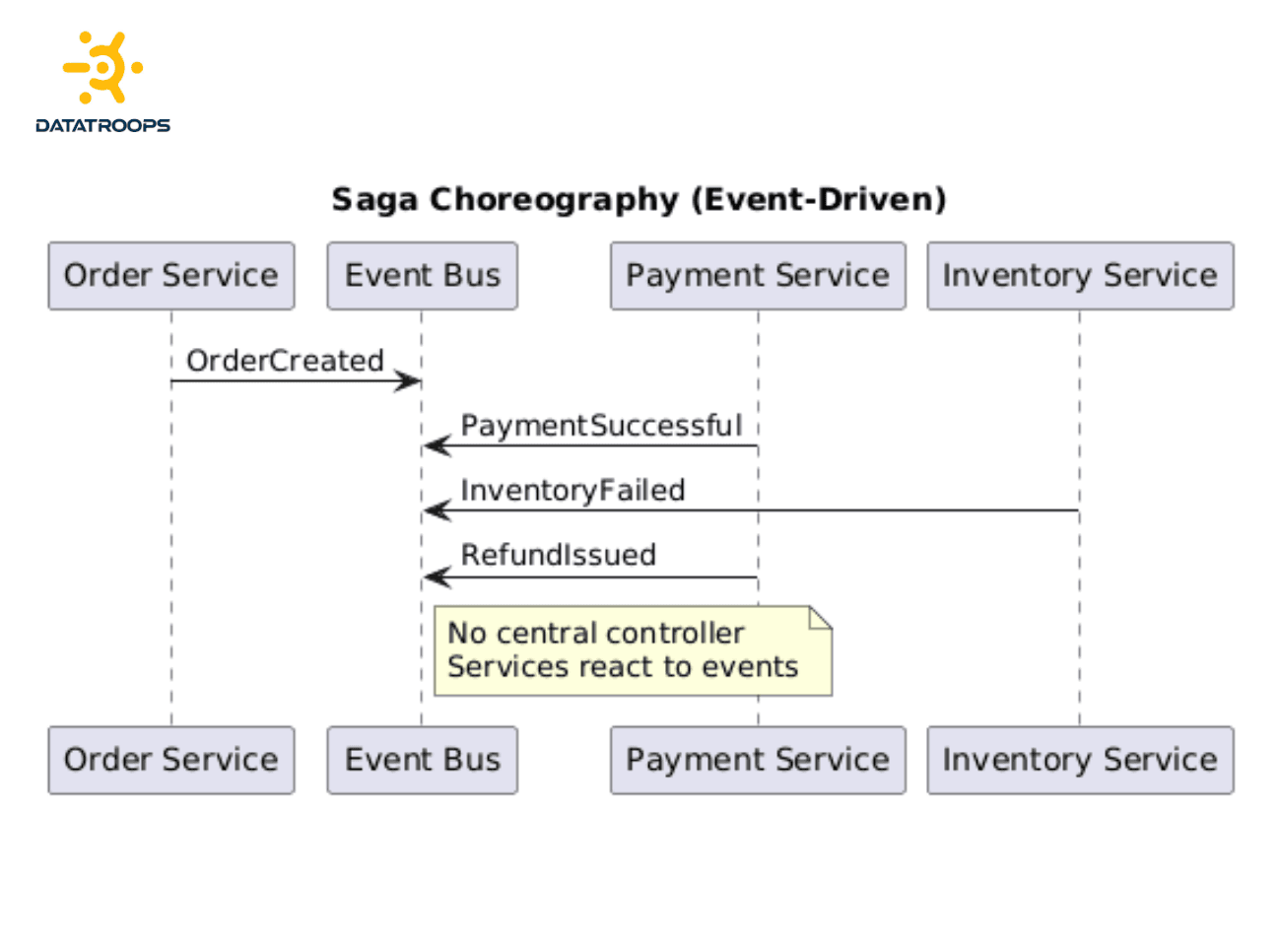
There are two main ways to coordinate these apologies: Choreography (services react to events) and Orchestration (a central conductor sends commands).
Choreography Code Example
@KafkaListener(topics = "order-created")
public void onOrderCreated(OrderCreated event) {
    try {
        charge(event.orderId());
        publish(new PaymentSucceeded(event.orderId()));
    } catch (Exception e) {
        publish(new PaymentFailed(event.orderId()));
    }
}
Orchestration Code Example
public void processOrder(Order order) {
    try {
        payment.charge(order.id());
        inventory.reserve(order.id());
        order.confirm();
    } catch (InventoryException e) {
        payment.refund(order.id());
        order.cancel();
    }
}
The Hidden Enemy: Idempotency
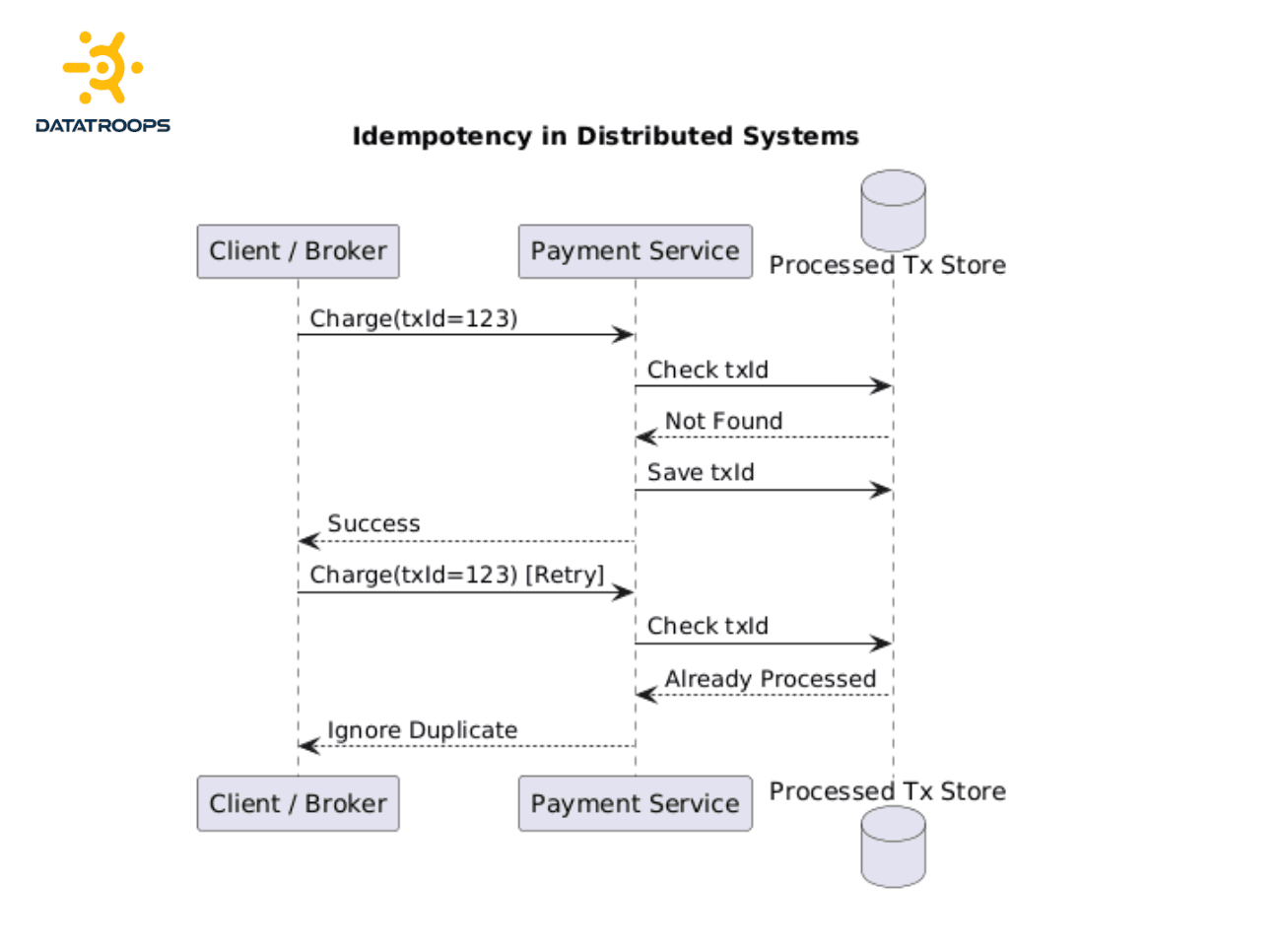
Distributed networks are flaky. Sometimes a 'Success' ack gets lost, and the Orchestrator retries. If your code isn't idempotent, you might refund Alice twice.
Critical Rule Every step in a Saga must be idempotent. Always check: 'Have I already processed this Transaction ID?'
Eventual Consistency and User Experience
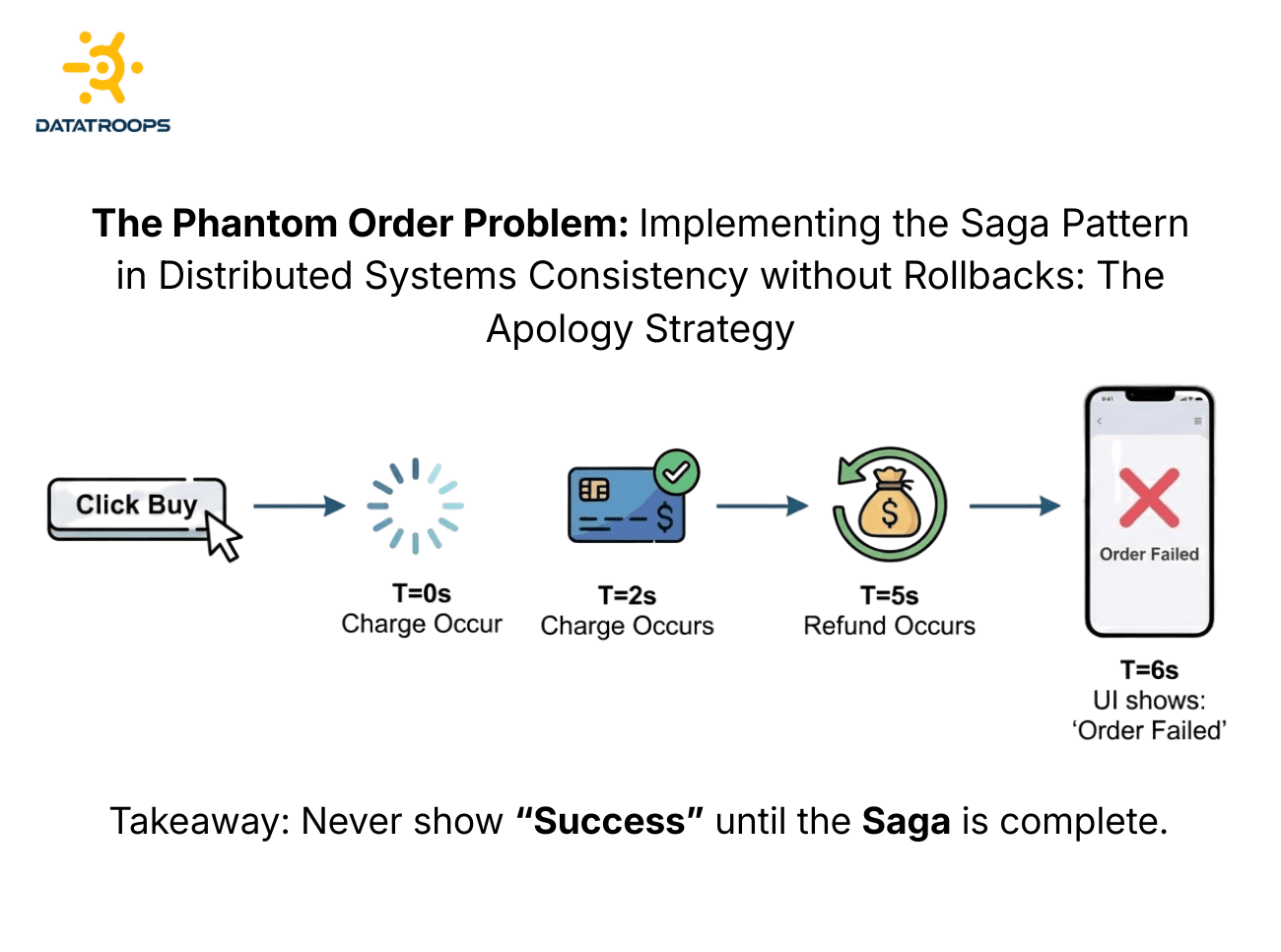
In a Saga, the user might see 'Processing...' for a few seconds. We prioritize Data Integrity over immediate UI consistency. Alice might see a charge on her phone before she gets an 'Order Failed' email. We must accept this window of inconsistency.
When NOT to Use Sagas
Sagas are complex and require writing double the code. Avoid them if:
- The action is irreversible (e.g., sending a legal contract).
- Strict consistency is legally required (e.g., core banking ledgers).
- It fits in one service: Architectural simplicity is often cheaper.
Final Summary
The 'Phantom Order' is a reality of distributed physics. We can't cheat time with rollbacks anymore. We have to be honest, face failure, and apologize. Microservices do not avoid failure—they are designed to survive it.
Build Resilient Distributed Systems
By submitting this, you agree to our Privacy Policy
Why Choose DataTroops for Distributed Systems?
We specialize in designing and implementing robust microservices architectures, handling complex distributed transactions, and ensuring data consistency across disparate services.
KEY TOPICS COVERED
- •Saga Pattern Implementation
- •Event-Driven Architecture
- •Resilient Service Integration
- •Distributed Transaction Management
- •Idempotent System Design
We're Ready To Talk About Your Opportunities
Let's discuss how we can help transform your ideas into successful products. Schedule a consultation with our expert team today.